What Do the Statistics on the Forschungszulage Tell Us – and What Do They Really Mean?
Summary
Process Overview
- 1Average rejection rate: 25.45%, with our support only 8%
- 2IT services & mechanical engineering leading in applications
- 3Bavaria, NRW & BW with the most applications
- 492% success rate through professional support
The Forschungszulage is one of the most attractive tax incentives for innovation projects in Germany – and it is widely used: particularly many applications come from IT services (32%) and mechanical engineering (20%). Regionally, Bavaria (24%), NRW (19%), and Baden-Württemberg (18%) lead. At the same time, rejections are not the exception: average BSFZ rejection rates from 2021 to 2025 were 25.45%. Those who document cleanly and correctly derive eligible costs can significantly improve their chances. That is exactly what dieforschungszulage.de specializes in – with 92% success rate, average 300.000 € in funding, and on average +25% higher funding.
Why This Article Matters (and What You Should Understand)
If you use the Forschungszulage, it is not just about "submitting an application". In practice, two things determine success, funding amount, and later security in a potential tax audit:
- Which costs can actually be claimed (and how to derive them correctly)
- How airtight project logic and documentation are (BSFZ logic, novelty, uncertainty, systematic approach)
I am Erich Lehmann (dieforschungszulage.de) – and this post aims to give you a clear, concise overview of the most important figures, rates, and patterns, so you can make better decisions.
1) Success Rate: How Often Is the Forschungszulage Approved?
Rejections are not the exception for the Forschungszulage. According to a BMBF document (24.06.2024), the success rate (per project, BSFZ) averages 74.55% – meaning roughly 3 out of 4 applications are approved.
What does that mean in practice? In 2024 (through May), the success rate is 71.11% (BSFZ). And that is where it gets interesting: at dieforschungszulage.de, the success rate in practice is 92% (corresponding to an 8% rejection rate).
Source: BMBF document dated 24.06.2024
2) Applications by Industry: Who Applies Most Frequently?
A look at the industries shows: the Forschungszulage is far from being "classical industry" only. My take: This is exactly where you can see why I deliberately speak of innovation in my wording: many eligible projects are product, process, or software innovations – not "lab research".
Source: bescheinigung-forschungszulage.de, retrieved 28 January 2026
3) Company Sizes: Is the Forschungszulage Only for Large Corporations?
No. The statistics show broad usage across all size categories: 32% each of applications come from micro enterprises and small enterprises, while medium-sized companies account for 22% and large enterprises for 13%.
So there is no "only corporations" or "only startups". The core insight is: what matters is not size, but sound R&D reasoning (novelty/uncertainty, systematic approach) plus correct cost logic.
Source: bescheinigung-forschungszulage.de, retrieved 28 January 2026
4) Applications by Federal State: Where Do the Most Come From?
Interpretation: The distribution roughly follows economic and industrial strength – and at the same time shows: the Forschungszulage is relevant nationwide.
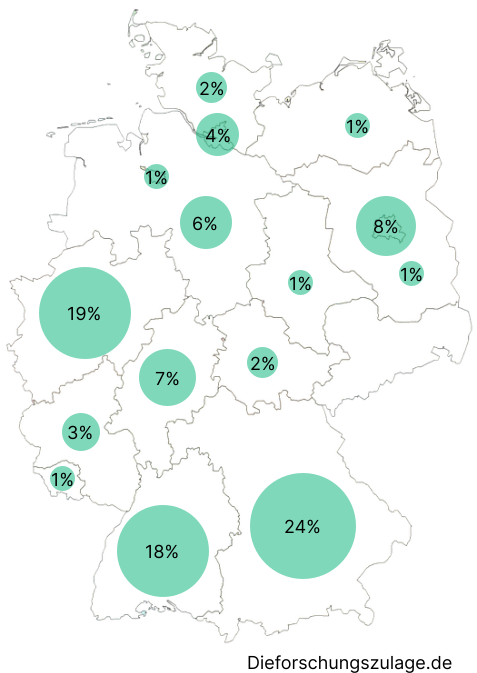
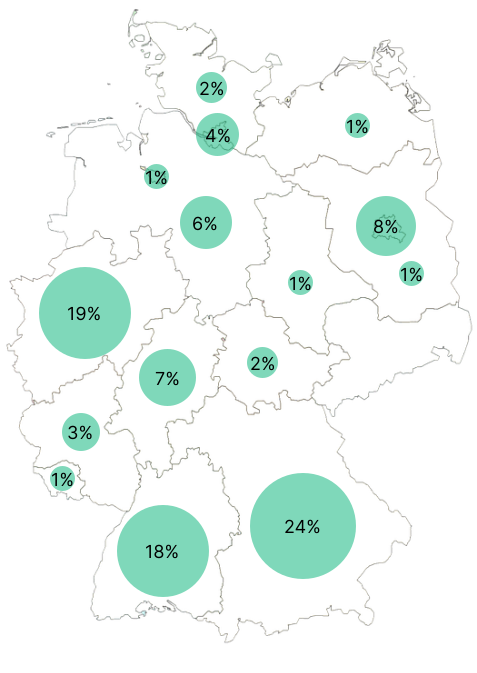
Source: bescheinigung-forschungszulage.de, retrieved 28 January 2026
5) What dieforschungszulage.de Has in Terms of Statistics (and Why It Matters)
I am frequently asked: "Do you really need a consultant?" My answer is pragmatic: if you want to save time, reduce risk, and optimize your funding amount – yes. Because the biggest levers are rarely in the "form", but in cost logic and project justification.
More money
€300k average funding
With us, companies often receive more money because we know which additional costs can still be claimed.
more funding through us
Less effort
Instead of 4 weeks, just 4 calls
We handle the writing. You only contribute your expertise in a few calls.
calls to submission
Higher success rate
Confidently through the tax audit
While the average is around 75%, we achieve 92% thanks to our watertight documentation.
success rate
Proven results
Trusted experience
We have already guided numerous companies successfully to the Forschungszulage (Public Funding).
Forschungszulage secured • 40+ customers
Our Process: Lean Instead of "4 Weeks of Application Pain"
Instead of weeks of self-directed work, many teams get there with us in 4 calls:
- Call 1 (Finance, ~30 min.): Document checklist tailored to your company (not a generic list)
- Call 2 (Finance Review, ~30 min.): We structure the data and clarify any open questions
- Call 3 (Product/Innovation, ~45 min.): Structure projects + assign employees/contractors per project
- Call 4 (Final/Submission): Review, finalization, submission
If you want to understand the process, start here: dieforschungszulage.de.
6) Official Sources: Where You Can Reliably Read More
For official information and procedures, the BSFZ is particularly relevant. If you want to start the process directly, the Bescheinigung platform is central: bescheinigung-forschungszulage.de.
Conclusion: The Forschungszulage Is Powerful – but Statistics Clearly Show: Documentation Decides
The Forschungszulage is an excellent option for claiming innovation expenses as a tax benefit. At the same time, the statistics show: rejections are common. Those who cleanly hit the BSFZ logic, clearly delineate projects, and correctly derive costs will significantly improve their chances – and additionally protect themselves for a potential future audit.
Do you still have questions about this topic?
We are happy to discuss your specific case in a free initial consultation. We'll find out in just a few minutes how much funding your company can receive.