How Do You Apply for the Forschungszulage?
Summary
You apply for the Forschungszulage in two steps: First, you submit a technical application to the Bescheinigungsstelle Forschungszulage (BSFZ), then a tax application to your tax office via ELSTER. The BSFZ application is free of charge, and processing takes about two months. You have a legal entitlement to the funding — if your project meets the criteria, it will be approved. The application can be filed up to four years retroactively and no pre-approval is needed. Depending on company type and time period, you receive 25–35% of your R&D expenditures back.
Overview: The Forschungszulage Application
Who Reviews Your Application? The Certification Body (BSFZ)
The Bescheinigungsstelle Forschungszulage (BSFZ) is the central body for the technical review of R&D projects. § 5 FZulG It receives applications via its online portal and distributes them to specialized institutes for assessment.
You cannot influence which institute reviews your application. Processing time varies depending on the institute and workload. If information is incomplete, you will receive a request for additional information — typically only one chance to respond. Prüfleitfaden BSFZ, Ch. 1.1.4: „If information on the three criteria is clearly incorrect or incomplete, applicant companies are given written opportunity to supplement or complete information within a reasonable deadline (supplementary request). If at least one criterion is clearly not met regardless of a supplementary request, no supplementary request is made for the other criteria.“ For amendment applications — when you need to modify an already certified project — processing is typically much faster than for initial applications.
Who Reads Your Application? Former Research Directors and Engineers
Your application is not read by administrators, but by technical experts with engineering backgrounds: former heads of research, engineers, programmers, and natural scientists. They assess based on the official review guideline whether your project meets the three R&D criteria. Prüfleitfaden BSFZ, Ch. 1: „Every research and development process consists of three essential parts: Start/Initial situation, Path to implementation, Goal: Product, process or service.“
This means: Write for engineers, not for managers. General or marketing-oriented descriptions like "innovative product" or "more revenue" will not convince the reviewers. Instead, they want to know specifically: What is the current state of the art? What exactly is technically new about it? What scientific or technical risk exists? Prüfleitfaden BSFZ, Ch. 1.1.2: „The BSFZ refers exclusively to scientific and technical aspects when assessing the uncertainty/risk criterion. Economic risks and uncertainties are not used to determine whether an R&D project within the meaning of the FZulG exists.“
How Is My Application Reviewed?
The reviewers work according to the official BSFZ Review Guideline — the central document that defines what qualifies as R&D and what does not.
The BSFZ reviews each project against three criteria (§ 2 FZulG). All three must be met. A detailed explanation can be found in the Requirements guide — here is the reviewers' perspective:
Novelty
Your project must aim for new knowledge or significantly improved products, processes, or services – measured against the state of the art in your industry.
Even small changes can be novel when existing technologies are combined in new ways. Routine changes are not eligible.
More on novelty →Uncertainty / Risk
There must be scientific or technical risks that could jeopardize the project goal. Economic risks do not count.
BSFZ risk definition: The original approach may not be feasible and requires an alternative or modified solution path.
More on uncertainty →Systematic approach
The project must be carried out systematically and documented – with clearly defined goals and a comprehensible methodology.
Agile development is fine – what matters is that the approach is technically sound and scientifically grounded.
More on systematic approach →Not every activity is automatically eligible — the BSFZ clearly defines in its review guideline what can be certified and what cannot (§ 2 (2) FZulG). The eligible phase ends, for example, already with the test of a prototype. Prüfleitfaden BSFZ, Ch. 2.1.2: „This includes, among other things, activities that primarily aim at the market development of a largely defined product or process, or aim to bring a production system to smooth operation. The R&D phase ends with the test of a prototype.“
What exactly the BSFZ funds, how to correctly classify your project, and which common mistakes to avoid — you can find all details in the Requirements guide.
Costs in the Application: How the BSFZ Plausibility Check Works
An important distinction: The BSFZ only checks your cost estimates for plausibility, not in detail. Prüfleitfaden BSFZ, Ch. 1.2: „Regarding information on financial and personnel framework, the BSFZ carries out a plausibility check "in principle". Lack of plausibility exists when the applicant company's information on personnel effort and/or contract costs is grossly inconclusive, contradictory, or erroneous.“ This means they check whether the information on personnel effort and costs is generally plausible — not whether every number is exactly correct.
What the BSFZ would flag as implausible: If an e-commerce company states that 100% of employees exclusively perform R&D. But if a technology company declares 20–30% of its personnel costs as R&D, that is understandable.
The recommendation: Estimate generously rather than conservatively. The detailed review only happens at the tax office — and there it is easier to approve less than to increase the amount retroactively.
Which cost types are eligible — including contract research (§ 3 (4) FZulG) and capital goods (§ 3 (3a) FZulG) — how the assessment base is calculated, and what changes from 2026, can be found in the Calculation guide.
Timing: When Should You Apply?
The Forschungszulage can be applied for up to four years retroactively (§ 6 FZulG). This makes it fundamentally different from traditional funding programs, where you apply in advance and then report on what actually happened.
Recommended strategy:
- Apply 1–2 years retroactively — for already completed project phases
- Include the current year in your plan
- Only plan ahead as far as you have reliable projections
The major advantage of retroactive application: You already know what was actually researched. No elaborate reporting, no deviations from the original plan — a common pain point with traditional EU funding programs.
New from 2026
For projects starting from 2026, there is an additional 20% overhead on top of eligible personnel costs. It may be worthwhile to plan your project start accordingly. More details in the Calculation guide.
Retroactive or Advance Application?
An important point: The BSFZ certificate covers the entire project — including its full duration. The tax office application is then submitted separately per fiscal year. So you use the same BSFZ certificate for multiple tax office applications.
This opens up two strategies:
Retroactively for multiple years at once — You apply for the BSFZ certificate for a project that has been running for 2–3 years, and then submit a separate tax office application for each past fiscal year. This is the most efficient approach because you know exactly what R&D expenditures were actually incurred. No estimating, no follow-up reporting.
Annually with the same certificate — You obtain the BSFZ certificate once and then submit the tax office application each year after the fiscal year ends. This is ideal for ongoing projects spanning multiple years.
In practice, we recommend a combination: Cover 1–2 years retroactively plus the current year with the initial application, then submit the tax office application annually for the completed fiscal year going forward.
Important regarding cost estimates: The costs you state in the BSFZ application must be plausible. If the actual expenditures later deviate significantly from the estimate, an amendment application at the BSFZ may be necessary — which takes time. Estimate realistically and err on the generous side.
Split projects strategically
Due to the changed funding rates from 2024 and 2026, it can be worthwhile to split projects so that expenditures fall into the more favorable funding period. The higher funding rates for SMEs and the new overhead allowances from 2026 make deliberate planning attractive.
Can the Application Be Changed After Submission?
At the BSFZ: Yes, but it requires effort. As long as the BSFZ is still processing the application or has already issued the certificate, you can submit an amendment application. This is necessary, for example, when costs have changed significantly, the project timeline has shifted, or new sub-projects have been added. Processing time for amendment applications is typically shorter than for initial applications — but it still means additional effort and waiting time.
At the tax office: No. Once the Forschungszulage application has been submitted to the tax office, changes are no longer possible. That is why it is critical that the information in the tax office application is correct and complete. If something changes about your project after the BSFZ certificate has been issued, you must first submit the amendment application to the BSFZ and wait for the new certificate before filing the tax office application.
Unsure whether your project is eligible? We're happy to check — free and without obligation.
What Happens at the Tax Office?
After receiving the BSFZ certificate, you submit the Forschungszulage application to the responsible tax office via Mein ELSTER (§ 6 FZulG). This is where it gets concrete — the tax office reviews the actual expenditures in detail:
- Gross salaries of employees involved in the R&D project
- Timesheets as proof of actual R&D working hours
- Employment contracts to verify the employment relationships
- Invoices for contract research and capital goods
- Correct calculation of the assessment base and compliance with caps
The project must essentially be the same one described to the BSFZ. If your project has changed substantially, you must first submit an amendment application to the BSFZ and obtain a new certificate before the tax office continues its review.
Tax audits do occur — especially for larger funding amounts, auditors will closely examine whether everything is consistent. Clean documentation from the start is therefore essential.
Tax exemption
The Forschungszulage itself is not taxable. It is treated as a tax credit and offset against the next income tax assessment. If no profits are available, it is paid out as a tax refund.
Want to maximize your funding? We handle the entire application process and documentation.
Forschungszulage vs. Traditional Funding Programs: Differences in the Application
If you have experience with ZIM, BMBF programs, or EU project funding, you know the typical process: submit a project application before starting, write interim reports, have milestones reviewed, provide proof of use — and in the end, explain why the project turned out differently than planned. The Forschungszulage application process is fundamentally different:
The biggest practical difference: With traditional funding, ongoing reporting is the pain point. With the Forschungszulage, you describe retroactively what actually happened — no explaining deviations from the plan, no follow-up reporting. But the quality of the BSFZ application becomes the decisive factor: Those who formulate too vaguely risk rejection or time-consuming revisions.
Why the Application Works Better with Us: Technical Expertise Meets Proprietary Software
Our founder Erich Lehmann is a developer himself. In a short conversation with your technical team, he understands what you are building and where the real novelty lies — without anyone needing to "translate." We then handle the entire application process: BSFZ application, project descriptions, cost calculation, tax office application, and communication on follow-up questions. You just bring your expertise — typically 4 structured calls are enough.
Proprietary Software Instead of Excel Chaos
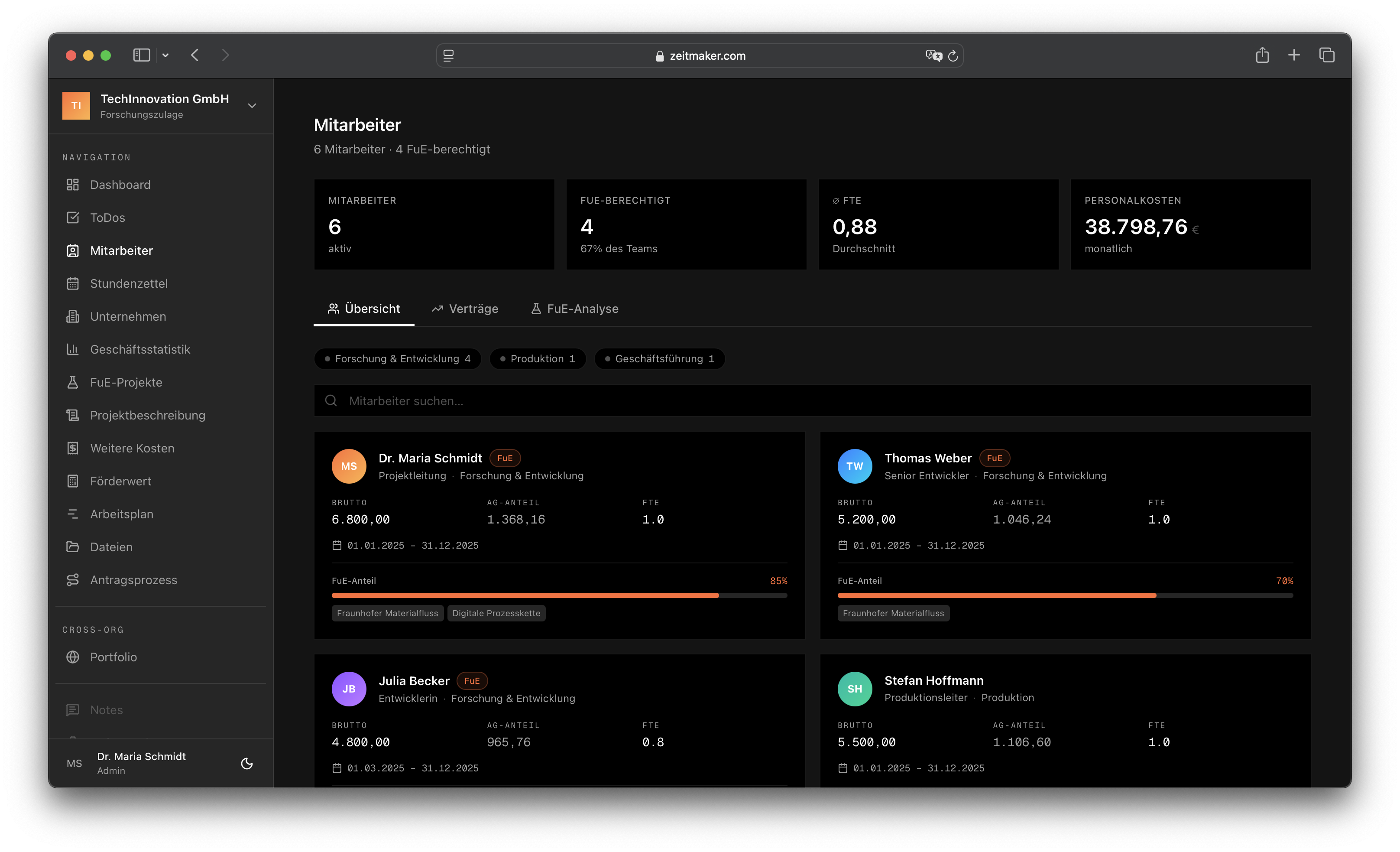
We do not work with Excel spreadsheets and Word documents. We have built our own software that supports us in the application process — so nothing gets overlooked and everything is correct.
- No calculation errors — Funding rates and caps automatically correct
- Audit-proof — Evidence prepared for tax audits
- Maximum funding — On average 25% more than self-filed applications
- Bulletproof — No inconsistencies like in Excel lists
Was sagen unsere Kunden?
“Super schnelle und effiziente Unterstützung bei der Forschungszulage. Der Prozess war in nur 4 Calls erledigt.”

“Erich erzielte eine Förderung von €350k pro Jahr und übertraf damit unsere Erwartungen um +€75k pro Jahr.”

“Erich hat uns sehr gut unterstützt und wir konnten uns auf unser Produkt konzentrieren. Extrem effizient in nur 4 Calls.”

“Sehr gute Arbeit und Dokumentation. Ich hatte extrem wenig Aufwand, alles war in 3 Calls erledigt.”

“Exzellente Unterstützung. Wir konnten unsere fliegenden Windkraftwerke schneller voranbringen. Nur 3 Calls benötigt.”

“Super schnelle und effiziente Unterstützung bei der Forschungszulage. Der Prozess war in nur 4 Calls erledigt.”
“Erich erzielte eine Förderung von €350k pro Jahr und übertraf damit unsere Erwartungen um +€75k pro Jahr.”
“Erich hat uns sehr gut unterstützt und wir konnten uns auf unser Produkt konzentrieren. Extrem effizient in nur 4 Calls.”
“Sehr gute Arbeit und Dokumentation. Ich hatte extrem wenig Aufwand, alles war in 3 Calls erledigt.”
“Exzellente Unterstützung. Wir konnten unsere fliegenden Windkraftwerke schneller voranbringen. Nur 3 Calls benötigt.”
Do you still have questions about this topic?
We are happy to discuss your specific case in a free initial consultation. We'll find out in just a few minutes how much funding your company can receive.